|
TNA: Looking North, Turning West?
By N. Sathiya Moorthy Oct 17, 2011 
| |
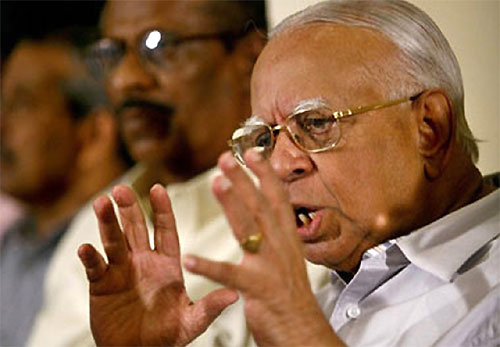 Reports that the Tamil National Alliance (TNA) leadership is planning to visit Washington, for follow-up discussions after the recent visit of US Assistant Secretary of State Robert Blake could invite mixed reactions from their Sinhala counterparts, both in Government and outside. For some, it would be an attestation of their claims about increased intervention by the international community (read: West) in the internal affairs of Sri Lanka. For others, it could mean a compatriot/competitor from Sri Lanka, for western patronage – in terms of politics and ideology, that is. American altruism in wanting the still-festering ethnic issue resolved in the context of its selfstyled role as a ‘global guardian’ – and not just a ‘global policeman’ -in the post-Cold War era should not be misunderstood. At the same time, the US should not overlook domestic criticism in Sri Lanka. It would not focus also on the presence of the LTTE rump on its soil, when the organisation is still banned in the country. Topping the list should be Viswanathan Rudrakumaran, the self-styled ‘prime minister’ of the ‘trans-national government of Tamil Eelam’ (TNGTE), who is both a US citizen and resident. Flowing from what critics in Sri Lanka would naturally see as ‘excessive American intervention’ will be a tilt towards China, when some of them otherwise might not have justifiable reason to doing so. They would tend to see the US involvement in the ethnic affair as an extension of revived American interest in the geo-strategic locale of Sri Lanka. Some would contextualise it to the US withdrawing/ having to withdraw troops from Afghanistan, and thus wanting a new foothold and activity in South Asia. Either way, the TNA could be blamed for ‘internationalising’ what to many in the Sinhala polity and almost all in the Sri Lankan Government remains an ‘internal issue’. Terms like ‘national question’ are comprehensive enough to exclude international involvement. In the past, Sri Lanka’s northern neighbour India and the far-away Norway could not take the peace process forward, after a point. It is not only the Sri Lankan Government that is a slippery customer. Their inadequate understanding of the stake-holders was a contributing factor. The Tamils, moderate or otherwise, are equally not uni-focussed. They are divided, too. India became a signatory to the 1987 accord because the Tamil moderates would not have the LTTE on board. Now, some in the TNA are talking tough, through and through. Others like Federal Party General Secretary Maavai Senathiraja have been working on what looks like a realignment of Tamil parties in a small way, in the name of organising mass protests on specific issues like land-registration in the North. Senathiraja’s party leader and TNA’s moderate face Sampanthan has contested one-time compatriot, Anandasangaree’s claims to being elected General Secretary of the near-defunct TULF recently. Sampanthan used to hold the position long ago, when the Front was united -and remained relevant before the LTTE intervened.The TNA fielding leaders of the four member-parties in most, it not all meetings and negotiations, could be described as being democratic. It is also a reflection of suspicions and egos. Whenever held, elections to the Provincial Council in the Northern Province will divide the TNA more than dividing the Tamil voters. The TNA’s reported visit to the West, including the US, could draw the finer lines for them, deeper than already. Meetings with US officials, top-down, and possible engagement with LTTE’s Rudrakumaran and company can have message(s) not only for the Sri Lankan Government and the Sinhala polity. It could have stronger ones for the Tamil community back home. After meeting with Indian Foreign Secretary Ranjan Mathai, TNA’s Suresh Premachandran reportedly said that New Delhi’s current suggestion for the fishers from the two countries to take up multiday, deep-sea fishing may not work on the ground. Given the competitive nature of Tamil politics in the North (as in Tamil Nadu, already) and rival EPDP Minister Douglas Devananda’s fishers-centric politics of the past year(s), the TNA’s constituency-centric interest in the fishing issue could have other implications, too. Following the meeting with Secretary Mathai, some TNA leaders also spoke about their Alliance, and also India, losing credibility with the Tamils if they did not deliver. If the idea for the TNA leadership to visit the US is to further the international pressure on the Sri Lankan State and the ruling polity in particular, it could cut both ways. While Governments cannot resist global pressure after a time, the global community can only take the horse to the water! The Tamils in Sri Lanka and the TNA otherwise should remember the dictum as much! It is they who have to live with the Sinhala community and society back home. Source: Daily Mirror - Sri Lanka
|
|
