|
Blame-game does not take JVP anywhere
By Sathiya Moorthy Oct 11, 2011 
| |
 Say, what is common between the AIADMK in Tamil Nadu and the ‘rebel JVP’ in Sri Lanka? Both are led by those that the parent movement sought to banish. Like Chief Minister Jayalalithaa leading the breakaway electoral face of the anti-Brahmin movement, the JVP rebels are now being led, among others, by Kumar Gunaratnam alias Kumar mahattaya, a Tamil. The comparison must end there.
The JVP’s is a strategy that went sour. In their transformation from a militant outfit to a moderate polity, the JVP leadership had confused the vote for the gun. When the gun could not sustain, and the vote was not a substitute, they lost. Nothing else explains their post-insurgency assumption of the past decades that their grassroots-level popularity, particularly in the rural South, should automatically turn into electoral seats, not just votes. True, other centreleft parties, including the SLFP, could do with the considerable number of JVP’s committed cadres, who could turn hopes into votes. That did not mean that they would vote the JVP, instead. It was a lesson that the JVP did not want to learn even after the drubbing in the 2006 local government polls. Having contributed substantially to Prime Minister Mahinda Rajapaksa’s electoral elevation as President only months earlier, the JVP, contesting alone this time, was a washout. The JVP voters had switched their loyalties even before President Rajapaksa had launched ‘Eelam War-IV’. In alliance politics, the JVP’s was a subsidiary role – ‘marginal utility’ in electoral terms. But the party had a problem acknowledging it. Beginning with 1994, when the SLFP, then under Chandrika Bandaranaike Kumaratunga, CBK, needed foot-soldiers to fight its electoral battles that too in the company of the traditional left with its ageing leadership and depleting membership, the moderate JVP seemed to have concluded that its day had arrived. It bit more than it could have chewed. In the process, the JVP seemed to have forgotten that for the cadres that it supplied, other allies were sharing their traditional vote-banks with the party. It was this confused conclusion, flowing from the party’s urgency to re-establish itself in democratic terms, which came a cropper when President Rajapaksa called its bluff on the Budget-2008 vote in Parliament. Like the ‘burgeoise’ parties that it had condemned, the JVP deluded itself, blaming horse-trading alone for the downward trend. Even so, Wimal Weerawansa was not the problem. He was the symptom. Today, the JVP is in the news not for those public protests on political and economic issues. It is over the current split in the party, which again the leadership refuses to acknowledge as a real threat. The leadership may still be intact but hopes of grassrootslevel revival are lost. Having offloaded the conventional leftist thinking that kept religion and ethnicity away from the socio-economic agenda of global socialism, the ‘Sinhala nationalist’ identity could not have taken the JVP anywhere, either with the gun or the vote. Nor could have the party competed with the centre-right ‘Sinhala nationalist’ politics of the JHU. Caught in between, and too late in its career, the JVP could not but have backed Sarath Fonseka in the post-war presidential poll of 2010. The desperation showed. With only JVP to back, Fonseka would have come a cropper. Expanding his support-base to include the UNP and TNA, the JVP came a cropper. The short-sightedness does not end there. The list is exhaustive. Competing for ideological identity with the rebels, for instance, party leaders have blamed India for splitting the JVP. The rebels in turn are still sworn by the anti-India diktat of Rohana Wijewera. Both need to look inwards for solutions to their problems. Externalising causes for failure as a habit does not help. In the South Asian neighbourhood, it has caused Pakistan dearly. Like Soviet and East European communism, the JVP too has problem adjusting to ground truths, which speak otherwise. The JVP rebels have denied reports that they were for reviving militancy or that they wanted to join hands with the ‘LTTE rump’. They did not have had anything to do with it, but they should be as alive as the Government, to any possible revival of ‘Sinhala Tigers’, as were called at the height of ‘Eelam War-IV’. Today, the JVP has moved away from where it could have re-oriented itself as a successful regional party, like the TNA in the North, or the SLMC in the East. Being overambitious and unrealistic, they, the party over-extended its resources and overreached itself. Post-insurgency political longevity has meant that the older ‘glory’ has been fading away with the passing generation(s). The JVP has only itself to blame.
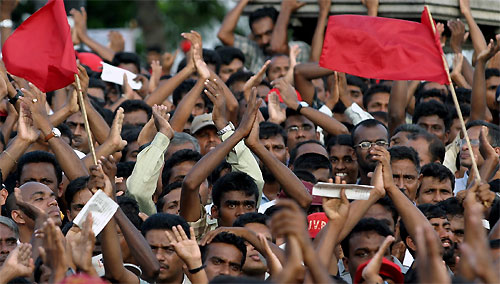 Source: Daily Mirror - Sri Lanka
|
|
